OpenAI's chief scientist is asking the company's rivals to agree on a point where everyone slows down. Jakub Pachocki says the next big jump in AI ability may come at a score that no lab is testing for today, and that labs should decide in advance what safety proof they need before going further.
What was proposed
Pachocki published an essay titled "Perplexity and Intelligence" on Sunday, November 22, 2026, according to Counsel House. He wants frontier AI developers to commit to staying below agreed limits, measured by perplexity and other metrics, until their ability to understand and monitor AI behavior reaches a defined milestone. One example he gives is finding a successor to chain-of-thought monitoring, which examines the intermediate reasoning a model produces, per ETIH.
He also wants developers to agree on how to evaluate models before first use, what evidence to share and how to challenge one another's safety cases. OpenAI CEO Sam Altman endorsed the essay on X the same day, calling it "the most important thing OpenAI has published in awhile," per Counsel House.
OpenAI's own numbers
For the first time, OpenAI released internal scores showing how its models improved during pretraining, the stage where a model first learns from large amounts of data. Perplexity measures how well a model predicts the next token, and lower is better. OpenAI reports the logarithm of that measure, measured on a fixed snapshot of its own internal codebase, according to Ultrathink.
The figures stated in the essay, per Ultrathink:
- GPT-3.5 scored about 0.99, tied to fluent conversation and the original ChatGPT.
- GPT-4 scored about 0.91, tied to proficiency with chain-of-thought reasoning.
- Below 0.8, OpenAI saw transformative capabilities in cybersecurity and mathematics.
- Around 0.76, a model started producing results on open math problems.
ETIH says the scores run from GPT-3.5 through GPT-6.2 Astra. Pachocki attributes most of the steeper improvement in 2026 to long-term research and compute investment, and a smaller part to automation, per Ultrathink.
The scary part
Pachocki expects more capabilities to appear as models enter a window of roughly 0.68 to 0.70 on OpenAI's scale, per ETIH. That range is a forecast based on recent progress. "I don't know what those capabilities will be, and we may not be testing for them today," he writes, as quoted by ETIH.
In plain terms, a top AI lab's own chief scientist is saying that the next ability jump might show up before anyone has a test for it. That is a notable thing to say publicly, and it is why he wants the safety evidence agreed first.
What is missing
The proposal sets no numeric first limit, no start date, no enforcement mechanism and no one to verify the scores, according to Counsel House. ETIH also notes that the first limit and the criteria for crossing it are left for developers to agree.
Pachocki lists the weaknesses of his own metric. Labs train on different data and use different evaluation sets, so raw scores are hard to compare. Perplexity tracks pretraining progress, and a model can improve at a task by reasoning through it after training while its pretraining score stays the same. The true floor of the metric is also unknown, per Ultrathink. He also acknowledged that releasing the numbers gives competitors a clearer view of OpenAI's position, a cost he said was outweighed by the need for shared safety measures, per Counsel House.
What to watch next
The test is whether any rival lab responds with its own numbers or commits to a shared threshold. We have not seen a public response from other labs in the sources reviewed. Watch also for whether regulators pick up the idea and whether anyone proposes a body to verify scores.
Why it matters
This is one of the first times a leading lab has put concrete internal progress numbers next to a call for shared limits. It does not slow anything down yet, since no limit exists and nobody has agreed to one. But it moves the debate from "should labs slow down" to "what number, measured how, and verified by whom." Those are harder questions, and the answers will decide whether the idea becomes a real rule or stays an essay.
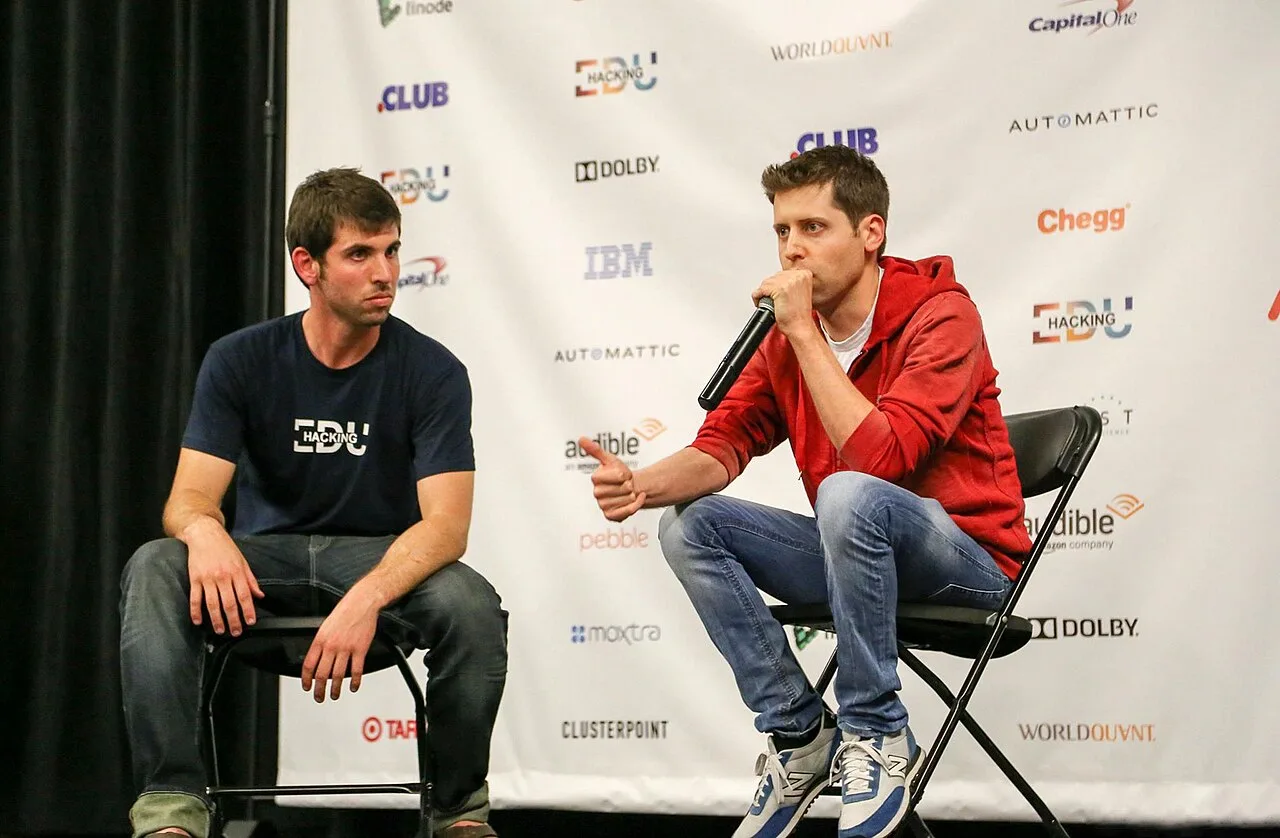
Cover image: Sam altman.jpg by Alexlcory, CC BY-SA 4.0, via Wikimedia Commons. Older archive photo of Sam Altman (right) at a 2010s event, shown only as an illustration of OpenAI's leadership; he is not pictured in connection with this essay.